
 |
||
 |
||
 |
||

| Angel Falls was the second film I directed at film school. The first one has been permanently committed to the annals of obscurity and banishment. Not that I'd have anything particularly against anyone seeing it - the script is available on this site. But tthe first film was a disaster, which I take full responsibility for.
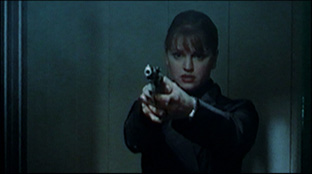
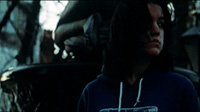
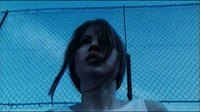
What makes these early films very amateurish were the constraints imposed upon us by the school. This was the second term project, in which everyone in the class would get a chance to direct their own film. We were split into groups of six students, and had six days to shoot six films, every day rotating into a new crew position. As well the films had to be non sync sound exercises - no sound was to be recorded during the shoot; only during post would sound be introduced. Students either got around this by having actors lip sync later - in which case everything ended up looking like a Spaghetti Western or a Hong Kong martial arts film, or not using voice at all. I tackled the limitation in the script - I'd make it about a girl who could read minds - thus no one had to be seen speaking to allow us inside their thoughts. What strikes me as funny now is the millennial ennui present with the year 2000 approaching. Angel Falls became the first film I felt a sense of accomplishment about. Now I see it and it's all wrong - the music's wrong, there are too many lingering closeups, and there is one very, very vital shot missing. But I am proud of the fact that I'd been awake some 32 hours when we shot it, and after three hours of sleep awoke the next day to haul all the equipment to Notting Hill to act as cinematographer on another student's film. I left fake bloodstains on the walls of my apartment hallway because I had no time to clean them. We ran so late into the night that our crew of six whittled down to two, myself and someone I still remember with a lot of admiration and respect, a Korean filmmaker named Dae Young Ghauck who taught me more about film aesthetics than any teacher ever did. To be honest, I preferred working that way. I am happiest as a director with an actor I appreciate and I'm operating the camera myself. It was also the second film in my school to have a stereo audio mix and was cut on a nonlinear system, something I did completely on my own initiative without the help of teachers, which led to the adoption of Avids at our film school. Sadly what I have here is a workprint telecine from VHS. And there was that detail about how with 400 feet of film stock allocated to each student we were supposed to make a minute long film. Although I got in some trouble for blatantly exceeding this, the teachers agreed it was unshowable in a shorter form. Through rigorous preplanning I went into this knowing every shot and there isn't a single second take of anything. But there was one enormous flaw in the film - this is the most important thing I learned shooting Angel Falls - to never give up the camera until you are absolutely certain you have everything you need. In this case it was one single shot.Just before Angel heads out of her apartment she was supposed to open a locked wooden box and pull out family photographs and the like and at the bottom, a revolver. The implication which is clearly there in the script is at this point early in the film, with the foreknowledge of her death being certain, that she is going to commit suicide. This was one single shot which we ditched to keep moving along fast. But it also makes for a logical explanation later on when she actually pulls a revolver out of her coat, out of nowhere. In fact it's the whole point of the film - something I completely failed... This character receives a prophetic vision of her own death and in the end decides that she would rather stand her ground and fight, despite knowing the cost of that to her own soul. But what keeps me attached to this film is the central performance by one Lucy Chalkley. I have no idea what has ever happened to this actress, who like most of the people we used at the film school were as young and hungry and ambitious as we were, fresh out of drama schools and trying to get their hands on anything they could. I don't think Lucy liked me very much - I was much more temperamental back then about shooting and it must've been silly to see me crafting my epic and demanding repeated rehearsals and gun safety drills when my fellow film students were much more laid back and fun than I was. In fact, I think Lucy really, really didn't like me and she got on my nerves occasionally but regardless she made me realize that I enjoy working with actors and their process. I well and truly believed that she was exceptional and hope she is still working. Film students have it tough when it comes to job prospects, but drama students have it way worse and in all my time in film school she was one of the few I met who I believed had some inner quality that's interesting to watch. The best compliment I ever got in film school was from two students after our screenings who said incredulously "you wrote that?" (which is perhaps very revealing about what people thought about me back then). But I think my voiceover is worthless without Lucy's reading of it, so much so that the best moment for me is the blank screen and all we hear are her words. Admittedly, there are some rather laughable moments, perhaps most notably the cameo by yours truly. Which I feel deserves an explanation. I really, really don't like being on camera. There are not many photographs of me in existence. But in this case I'd jury rigged a contraption which would allow me to use squibs - the small directive explosives combined with a blood pack which make it appear someone is getting hit by bullets. Well I didn't so much acquire these professionally as much as I sort of made them. I think one of the highlights of my film school experiences had to be riding a train two hours outside of London and buying specialized pyrotechnic explosives in the back of a stranger's car. The result being that no one would agree to be the psycho stalker who has to wear the explosives, so when you see me show up about fifty pounds heavier... Feel free to laugh but know I had the best intentions. Enough excuses. My goal in making films has always been to capture a mood or an emotional state, and I believe that this is the first time I started to understand that, so I will always be fond of it. |
 |
|
 |
||